Main issues
The foreign exchange market
Conventions for quoting the spot exchange rate
Bid-ask spreads and transaction costs
Arbitrage and the law of one price
The Spot Market for Foreign Exchange
The foreign exchange market
Conventions for quoting the spot exchange rate
Bid-ask spreads and transaction costs
Arbitrage and the law of one price
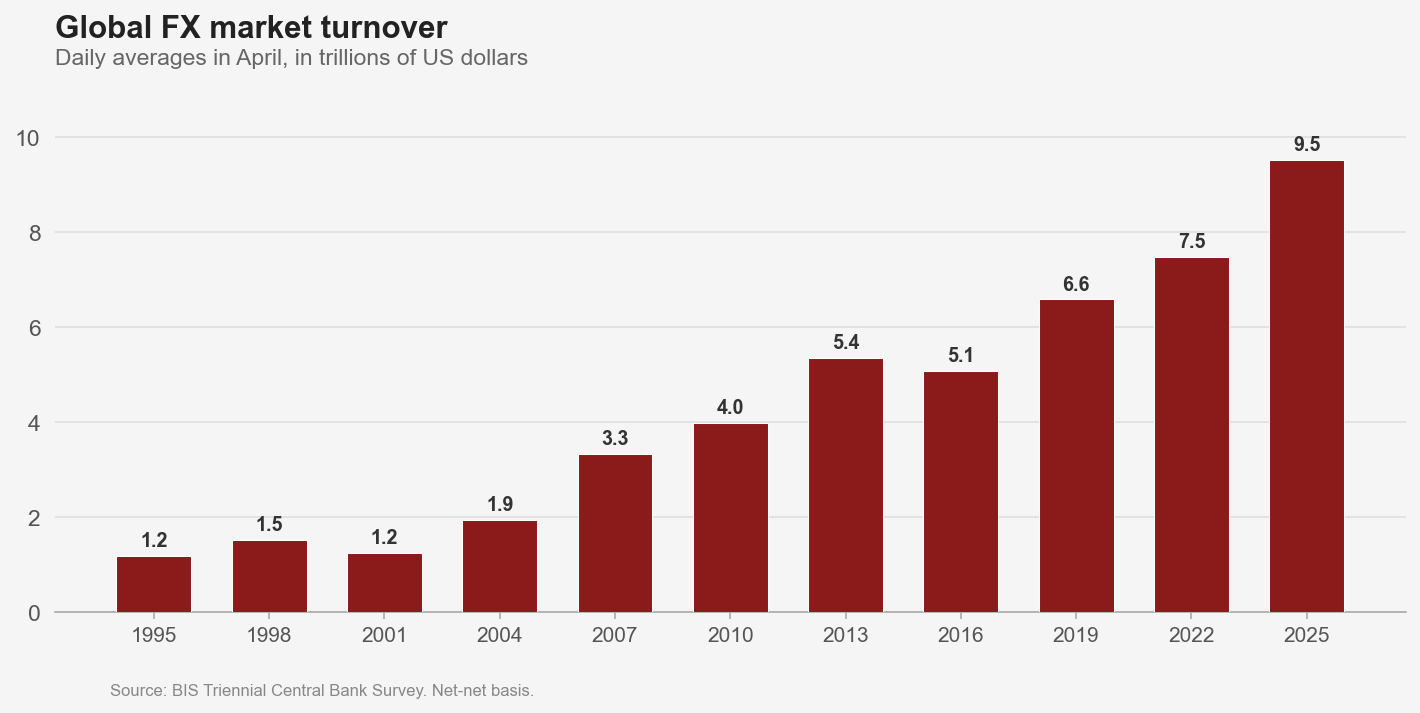
Decentralized, global, over-the-counter (OTC) market for exchanging currencies
The largest financial market in the world
Open nearly 24 hours — follows the sun:
Sydney → Tokyo → London → New York
Three questions:
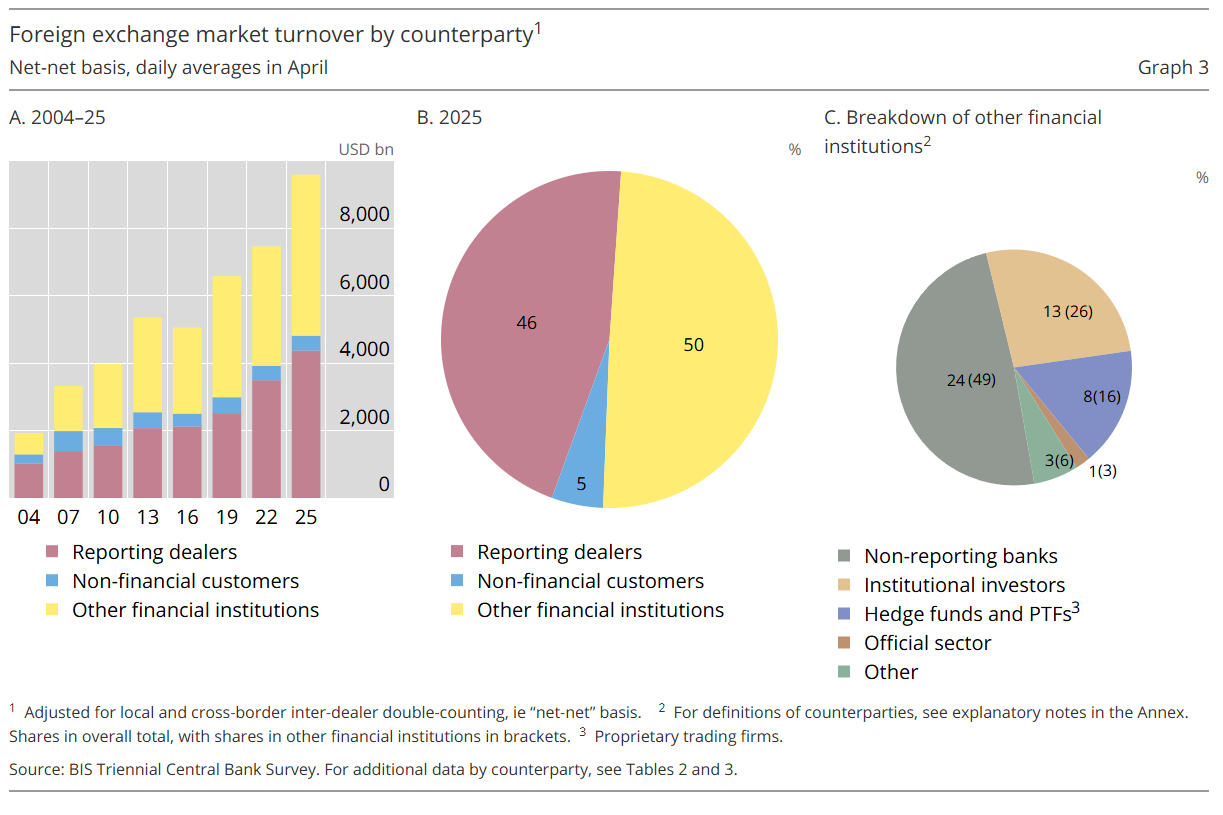
Source: BIS Triennial Central Bank Survey (2025)
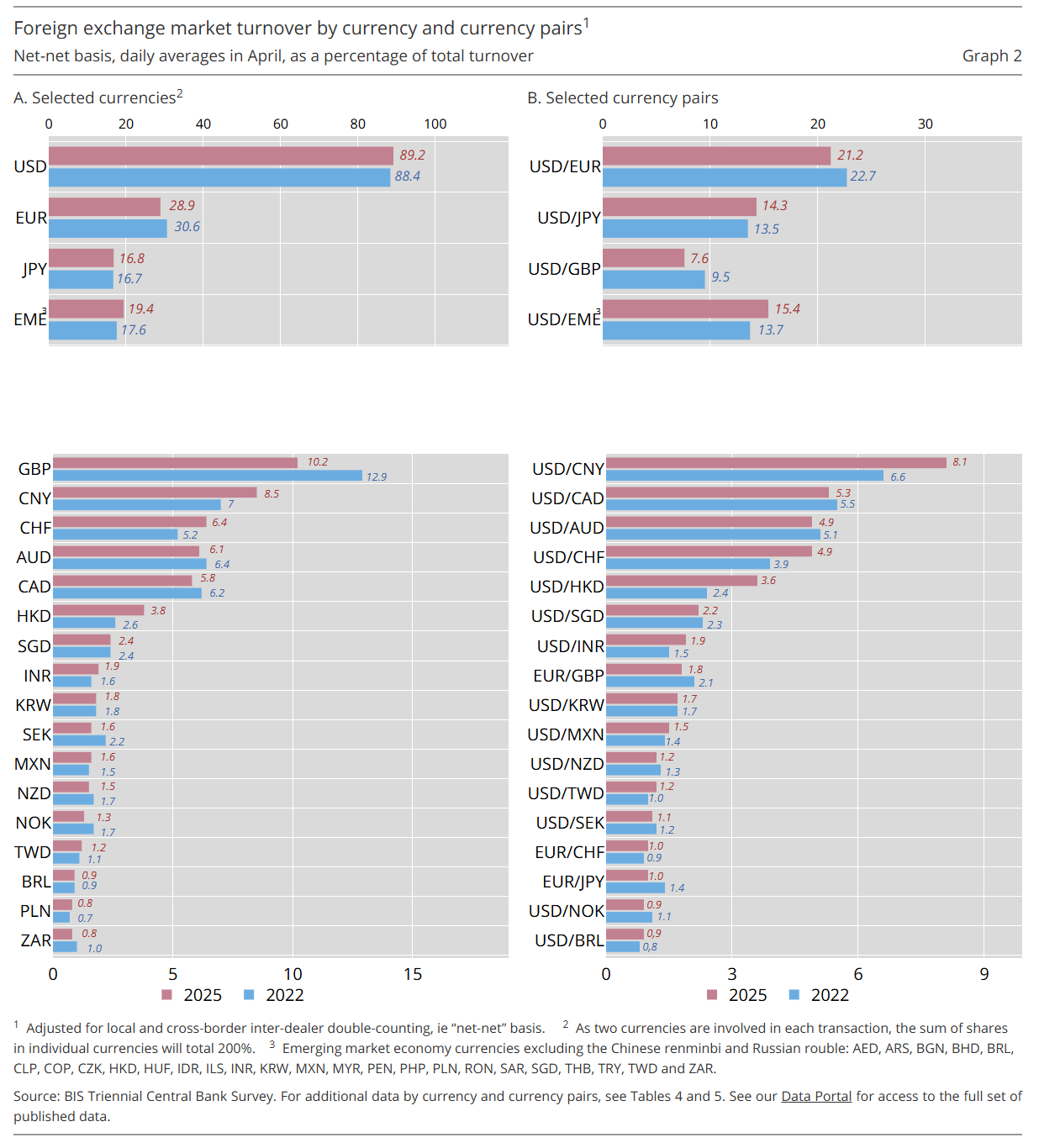
Source: BIS Triennial Central Bank Survey (2025)
Source: BIS Triennial Central Bank Survey (2025)
Reporting dealers (banks): Make markets, warehouse risk, provide liquidity
Other financial institutions: Asset managers, hedge funds, central banks, pension funds
Non-financial corporations: Hedging commercial FX exposures
Retail: Small fraction; mostly via online platforms
The market has shifted heavily toward electronic trading (EBS, Reuters Matching, multi-dealer platforms).
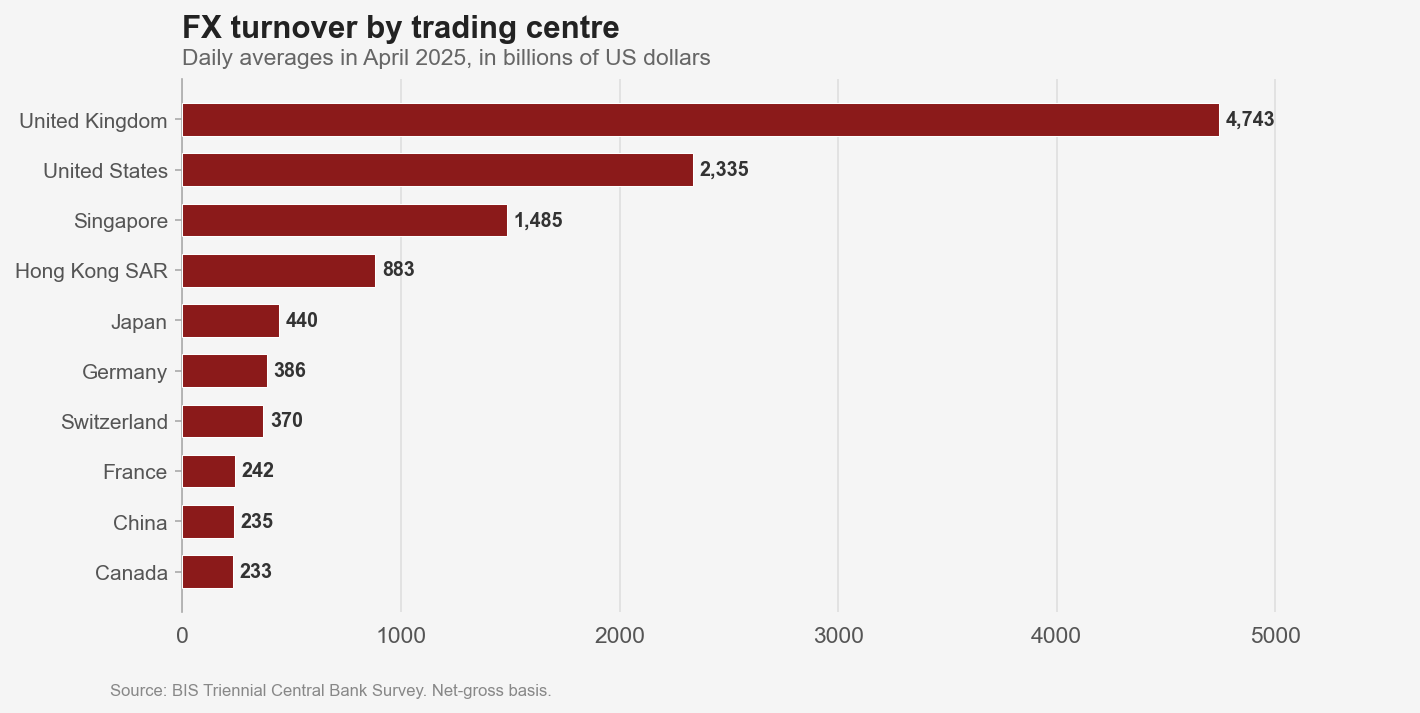
Source: BIS Triennial Central Bank Survey (2025)
Source: BIS Triennial Central Bank Survey (2025)
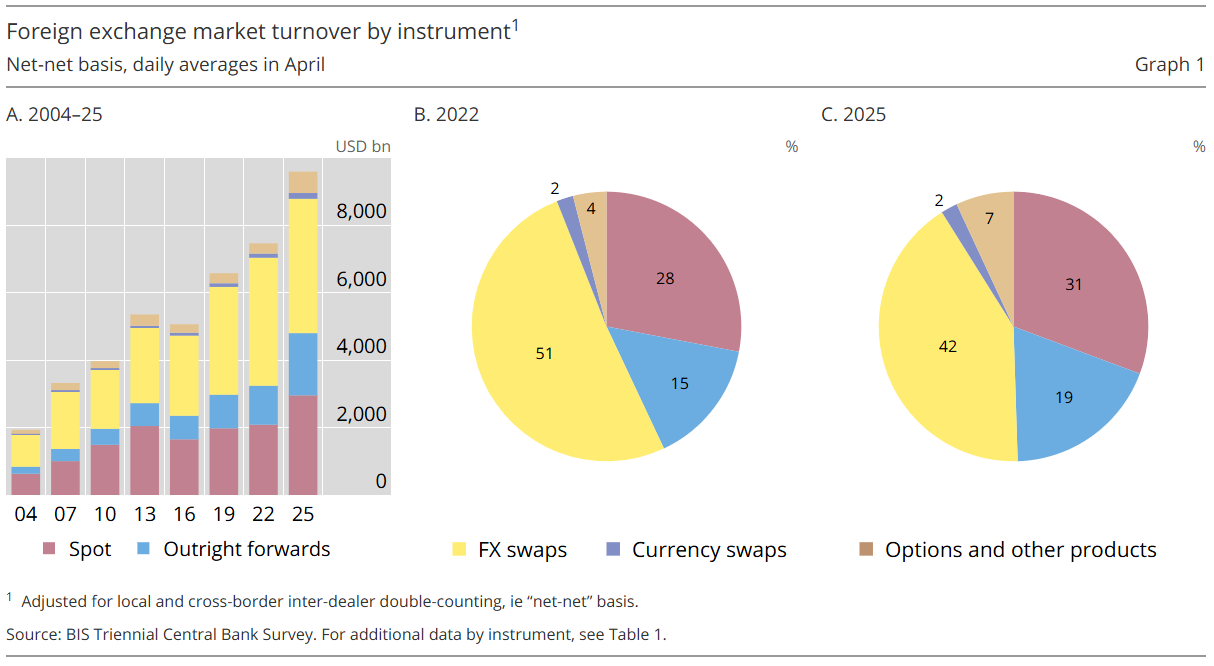
| Instrument | Share of turnover |
|---|---|
| FX swaps | ~42% |
| Spot | ~31% |
| Outright forwards | ~18% |
| Options & other | ~8% |
The forward and swap markets are larger than spot.
We cover forwards in Lecture 3, swaps in Lecture 6.
Spot market:
Forward market:
We need to understand spot first — forward prices are derived from spot plus interest rates.
The spot rate \(S_t\) is the amount of home currency (HC) per one unit of foreign currency (FC):
\[S_t = \frac{\text{HC}}{\text{FC}}\]
Think of it as a price:
Direct (natural) quote — our convention:
Indirect quote:
Warning: Market convention is inconsistent. “EUR/USD = 1.10” means USD per EUR in practice. We always use HC/FC.
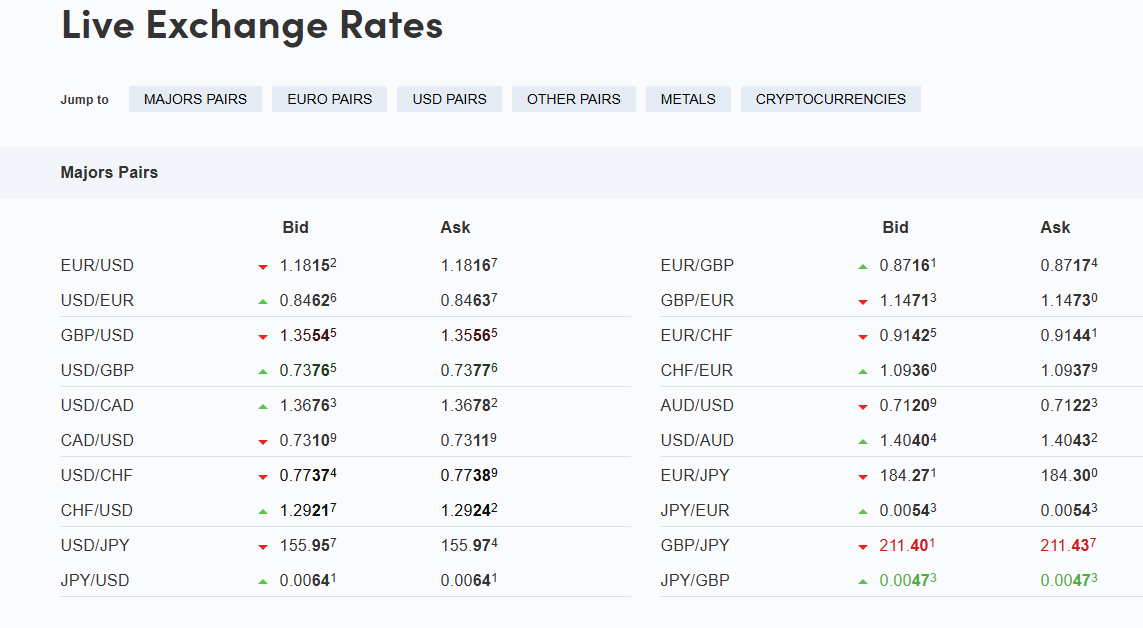
Source: OANDA
To find the cross rate between two non-USD currencies, go through USD:
\[\frac{\text{FC}_1}{\text{FC}_2} = \frac{\text{FC}_1}{\text{USD}} \times \frac{\text{USD}}{\text{FC}_2}\]
Example: Find CHF/GBP given CHF/USD = 0.88 and USD/GBP = 1.27
\[\text{CHF/GBP} = 0.88 \times 1.27 = 1.118\]
Why? USD is the vehicle currency — almost all FX transactions go through USD, even when neither party wants dollars. USD liquidity is the spine of the FX market.
The % appreciation of currency A against B does not equal the % depreciation of B against A.
Example:
| Calculation | Result | |
|---|---|---|
| USD appreciated by | \((1.50 - 1.00)/1.00\) | +50% |
| CAD depreciated by | \((1/1.50 - 1/1.00)/(1/1.00)\) | −33.3% |
The discrepancy grows with the size of the move.
Rule: Always define which currency is the “asset” and compute changes consistently.
When you trade FX, you face two prices:
Always: \(\text{Ask} > \text{Bid}\)
The bid-ask spread = Ask − Bid
This is the dealer’s compensation for providing liquidity and warehousing risk.
| Factor | Effect on spread |
|---|---|
| Liquidity | Major pairs (EUR/USD): 1–2 pips. Exotic pairs (USD/TRY): 50+ pips |
| Volatility | Spreads widen during stress (2008, 2020) |
| Trade size | Institutional spreads < retail spreads |
| Time of day | Spreads widen outside major session overlaps |
Spreads are a transaction cost — they directly affect hedging costs and arbitrage bounds.
Source: OANDA
To convert HC/FC quotes to FC/HC quotes:
\[(\text{FC/HC})_{\text{bid}} = \frac{1}{(\text{HC/FC})_{\text{ask}}}\]
\[(\text{FC/HC})_{\text{ask}} = \frac{1}{(\text{HC/FC})_{\text{bid}}}\]
Why? The bid must always be the smaller number. Inverting the larger direct quote gives the smaller inverse quote.
Given: USD/EUR bid = 1.0950, ask = 1.0955
Find: EUR/USD bid and ask
\[(\text{EUR/USD})_{\text{bid}} = \frac{1}{1.0955} = 0.91282\]
\[(\text{EUR/USD})_{\text{ask}} = \frac{1}{1.0950} = 0.91324\]
Check: bid < ask ✓
Use the law of the worst possible combination:
\[(\text{FC}_1/\text{FC}_2)_{\text{ask}} = (\text{FC}_1/\text{USD})_{\text{ask}} \times (\text{USD}/\text{FC}_2)_{\text{ask}}\]
\[(\text{FC}_1/\text{FC}_2)_{\text{bid}} = (\text{FC}_1/\text{USD})_{\text{bid}} \times (\text{USD}/\text{FC}_2)_{\text{bid}}\]
Example: CHF/USD 1.1520–1.1530, USD/EUR 1.2840–1.2850
Arbitrage:
Shopping around:
Quotes:
Trade:
This cannot persist — massive trading eliminates the opportunity instantly.
No-arbitrage condition: Dealer quotes must overlap.
Quotes:
No arbitrage (X’s bid < Y’s ask). But:
Can be intentional — inventory management. But unsustainable for both banks if they want to stay active in the market.
Rates: EUR/USD = 0.9, CHF/USD = 1.5, EUR/CHF = 0.66
Implied EUR/CHF = EUR/USD × USD/CHF = 0.9 × (1/1.5) = 0.60
Market EUR/CHF = 0.66 → CHF is too expensive in EUR
Trade (start with EUR 0.9m):
Profit: EUR 0.09m — riskless, no net capital. In practice, electronic trading closes these gaps in milliseconds.