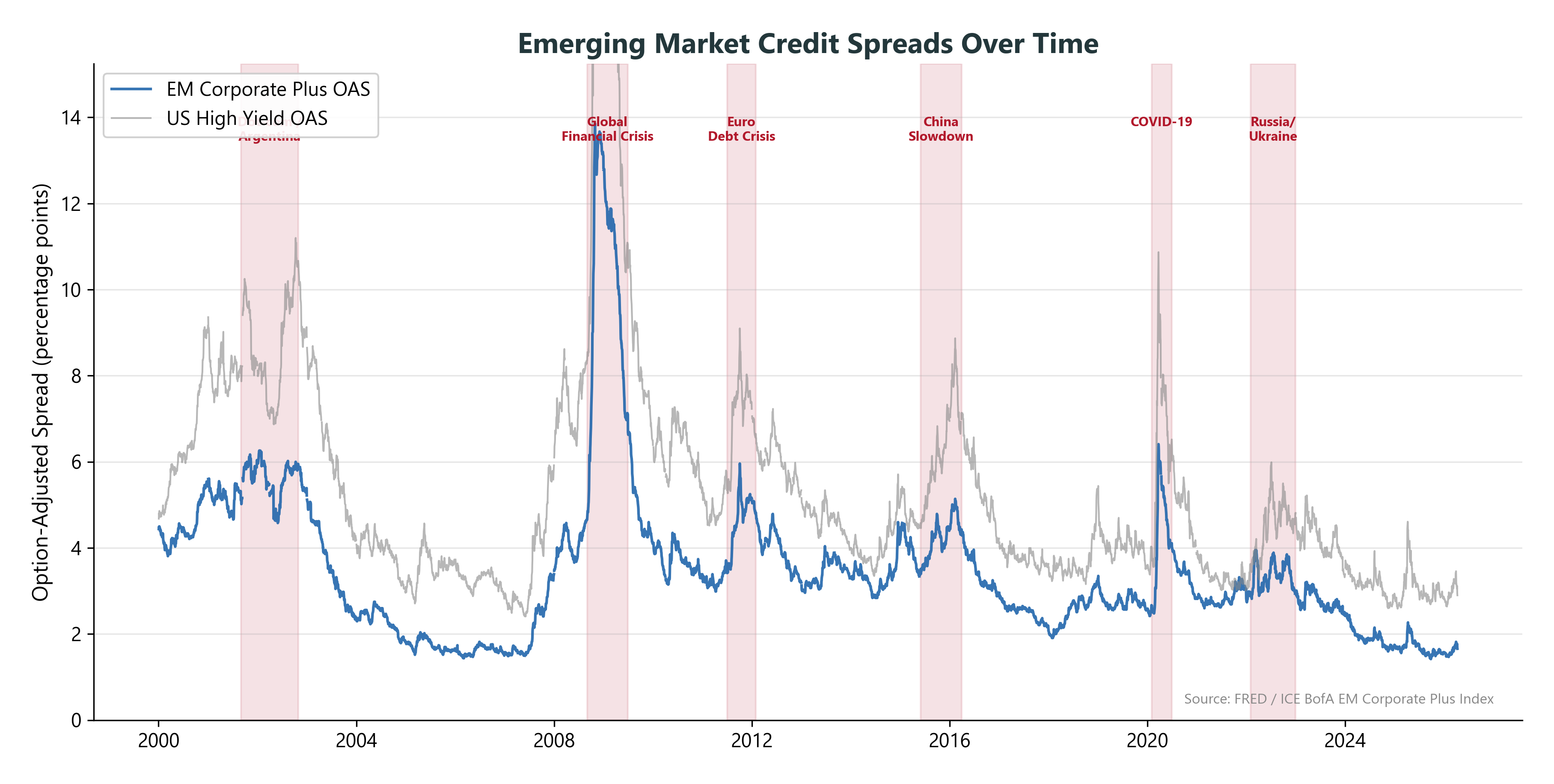
Note: this is an emerging-market corporate OAS series (ICE BofA EM Corporate Plus). It is a high-frequency proxy for EM credit conditions and risk appetite, not a pure sovereign default spread.
From Spreads to Default Probability
The spread implies a market-priced default probability:
Sovereign bond promises \(\$113\) (at 13% yield)
Market values it at \(\$106\) (= \(\$100 \times 1.06\), the Treasury return)
Covers book value, not market value; sudden events covered best
Summary: Measurement Tools
Tool
Pros
Cons
Sovereign spreads
Market-based, real-time
Volatile, credit + liquidity mixed
Credit ratings
Standardized, stable
Lag events, coarse
Political risk indices
Granular, forward-looking
Subjective, infrequent
Insurance premiums
Deal-specific, market-priced
Book value, limited coverage
In practice, use multiple measures together
No single measure captures all dimensions of country risk
Part 3: The 500bp Fallacy
Common Practice: Adjust the Discount Rate
Many practitioners simply add the sovereign spread to WACC:
US project WACC: 10%
Brazil sovereign spread: 5%
Brazil project WACC: 10% + 5% = 15%
This is called the “500 basis point” approach
This is wrong. It’s convenient, widespread, and fundamentally flawed.
Why It’s Wrong: Problem 1 — Double-Counting
The sovereign spread is already reflected in local interest rates
If you use the local risk-free rate to build your WACC, the spread is already there
Adding it again means you’re counting country risk twice
If you use the US risk-free rate + ICAPM (Lecture 11), you already have the systematic component
The ICAPM discount rate from Lecture 11 already prices whatever systematic component of country risk exists
Why It’s Wrong: Problem 2 — Not All Projects Are Equal
Adding a uniform spread assumes all projects in a country face the same risk
But consider two projects in the same country:
Project
Country Risk Exposure
Export-oriented gold mine
Low: revenues in USD, global buyers
Domestic retail chain
High: local revenues, local regulation
Same country spread, but very different country risk exposure
The DR approach treats them identically — that’s wrong
Why It’s Wrong: Problem 3 — Systematic vs Idiosyncratic
An important component of country risk is country-specific (diversifiable)
Finance theory: only systematic risk deserves a risk premium in the discount rate
Many country-specific events (a single sovereign default, a localized political crisis) are largely diversifiable for a global investor
The ICAPM from Lecture 11 already captures whatever systematic component exists
However: market measures like spreads also embed global risk appetite, dollar liquidity conditions, and contagion effects — so observed spreads are not purely idiosyncratic
Implication: country risk should primarily affect expected cash flows, not the discount rate — but recognize that not all of it is purely diversifiable
Why It’s Wrong: Problem 4 — Ignores Deal Structure
Deal structuring can reduce country risk substantially:
Political risk insurance (MIGA, ECAs, private insurers)
Joint ventures with credible local or international partners
International arbitration and stabilization clauses (ICSID)
Revenue in hard currency, debt in local currency
Critical technology/IP kept offshore where feasible
Adding a flat spread ignores all of these protections
Why It’s Wrong: Problem 5 — Overstates Risk for Long-Lived Projects
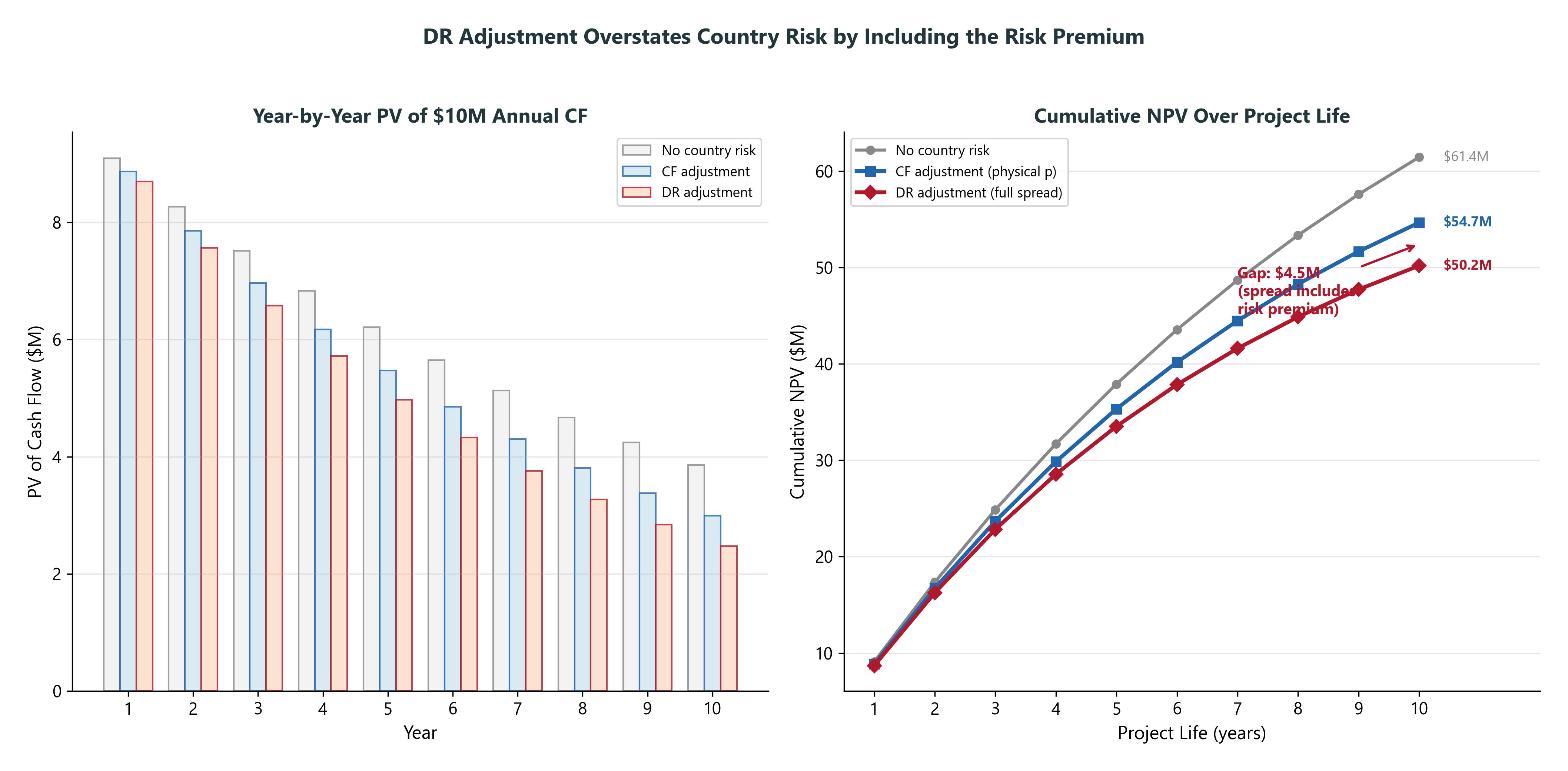
Adding the full sovereign spread to the discount rate overstates country risk because the spread includes a risk premium above the actual expected loss
Interlude: Managing Country Risk Before Valuing It
Proactive Management: Reduce Risk Before Pricing It
Country-risk valuation should measure residual risk after feasible mitigation.
Same country, same sovereign spread — different project exposure.
Managers can reduce: probability that an event affects the project; loss given event; timing of disruption; ability to repatriate or redeploy cash; recovery value on exit.
These choices enter valuation via: expected cash flows; scenario probabilities and loss severities; insurance premia/deductibles; APV side effects; exit and abandonment options.
Do not value “country risk in Vietnam.” Value the residual country risk of this specific Vietnam deal.
Transfer Risk: Not All Cash Flows Are Equally Vulnerable
When hard currency becomes scarce, host countries restrict payment channels in roughly this order:
Payment channel
Typical vulnerability
Capital-account transfers
Often blocked first
Dividends / profit repatriation
Ceilings, delays, approvals
Interest / royalties / license fees
More defensible if documented
Trade / technical / management fees
Restricted mainly in severe cases
Establish legitimate, recurring, arm’s-length payment channels before a crisis. Once controls are imposed, it is too late.
Structures must be legal, documented, and arm’s-length.
Proactive Design Levers
Financing and insurance: political-risk insurance (MIGA, ECAs, private insurers); local or third-party debt; DFI / multilateral co-investment (IFC, EBRD, World Bank group).
Contracts and governance: JV with a credible local partner (trades political risk for agency risk); international arbitration and stabilization clauses (ICSID); hard-currency revenues / offtake contracts; local-currency debt as a natural hedge.
Operational levers: keep critical technology/IP offshore where feasible; stage investment to preserve abandonment options.
These protections do not “lower the country spread.” They change the project’s expected cash flows and residual loss distribution.
How Proactive Management Enters APV
APV with residual country risk:
Base-case operating value at the ICAPM rate
Financing and structuring side effects: local-debt tax shields; DFI/ECA guarantees; JV dilution or partner fees; insurance premiums
Residual country-risk adjustment: scenario cash-flow haircuts; insurance deductibles and uncovered losses; delays in compensation; uninsurable sanctions, capital-control, or climate-policy risks
The country-risk adjustment is not exogenous. It depends on the chosen structure.
The Right Approach
Separate the discount rate from country risk; value the residual:
Discount rate — ICAPM / globally integrated capital-market discount rate. Captures systematic risk only (world market and currency factor betas); no country-risk premium added.
Expected cash flows — adjust for residual country risk after feasible mitigation. Scenario-weighted; deal-specific (insurance, JV, debt structure, arbitration clauses).
APV components — separately value insurance premiums, local financing effects, tax shields, guarantees, and other structuring side effects.
The correct country-risk adjustment is deal-specific, not country-generic.
Part 4: Cash Flow Adjustment Methods
Method 1: Bond-Implied Default Probability
Use sovereign spreads to compute annual default probability, then “haircut” cash flows:
Step 1: Extract default probability from spread (quick hazard-rate approximation)
Spread = 4%, recovery rate = 5%
\(p \approx \dfrac{\text{spread}}{1 - \text{recovery}} = \dfrac{0.04}{0.95} \approx 4.2\%\) per year
Useful for a first pass, but it compresses credit risk, liquidity, the credit risk premium, and recovery assumptions into one number. The earlier one-period bond-pricing derivation is related but not identical.
Step 3: Discount at ICAPM rate (no country premium!)
Method 1: Worked Example
Year
Base CF
\((1-p)^t\)
Adjusted CF
PV at 10%
1
$10.0M
0.958
$9.58M
$8.71M
2
$10.0M
0.918
$9.18M
$7.59M
3
$10.0M
0.879
$8.79M
$6.61M
4
$10.0M
0.842
$8.42M
$5.75M
5
$10.0M
0.807
$8.07M
$5.01M
PV of CFs
$33.67M
Assumptions: \(p = 4.2\%\)/year (spread 4%, recovery 5%), ICAPM rate = 10%, base CF = $10M/year. No initial investment subtracted — this is a PV of cash flows, not an NPV.
Method 1: Limitations
This approach assumes:
Binary outcome: either the project survives or it’s a total loss
Reality: many country risk events cause partial loss (tax increase, regulatory change)
Constant default probability: same \(p\) every year
Reality: risk changes over time (elections, commodity cycles)
Same risk for all projects: uses sovereign default as proxy
Bottom line: good for a quick estimate, but too crude for large investments
Method 2: Scenario Analysis
Define country-specific scenarios and assign probabilities:
Scenario
Prob.
CF Impact
Weighted CF
Base case (stable)
60%
$10.0M
$6.00M
Mild deterioration
20%
$7.0M
$1.40M
Severe crisis
12%
$2.0M
$0.24M
Expropriation
8%
$0.0M
$0.00M
Expected CF
$7.64M
More flexible than bond-implied method
Can model partial losses (not just binary)
Can vary scenario probabilities over time
Method 2: Strengths and Weaknesses
Strengths: captures partial losses and multiple risk types; reflects proactive choices (insurance, local debt, JV, arbitration, exit rights, staged investment); allows time-varying probabilities; forces explicit thinking about what can go wrong.
Weaknesses: probabilities are subjective (who decides 8% expropriation risk?); sensitive to scenario design (missing scenarios bias the answer); can be manipulated; hard to audit or benchmark across projects.
Scenario probabilities and loss severities should reflect deal-specific protections, not country-level averages.
Method 3: APV with Political Risk Insurance
“Probably the best approach” — market-priced, deal-specific.
Base case uses the ICAPM rate from L11 and base-case cash flows
Premiums are quoted by MIGA / ECAs / private insurers
Residual losses include deductibles and uncovered sanctions, war, or contract exclusions
Method 3: Advantages
Market-based and deal-specific
Prices the actual risks the insurer is willing to cover
Separates insured and uninsured country-risk exposure
Fits naturally into APV
Method 3: Caveats
Coverage may be unavailable for some countries, sectors, or events
Often covers book value or defined losses, not full market value
Compensation can be delayed
Covert expropriation or regulatory harassment may not trigger coverage
Sanctions, war, or contract exclusions can leave residual risk
Insurance reduces risk; it does not eliminate all country risk
Comparing the Three Methods
Method
Best For
Key Limitation
Bond-implied CF
Quick estimate
Binary outcome only
Scenario analysis
Complex, multi-risk
Subjective probabilities
APV with insurance
Deal-specific valuation
Not all risks insurable
Never recommended: adding a spread to the discount rate
In practice, use Method 3 as the primary approach, supplemented by Method 2 for uninsurable risks
Method 1 is useful for back-of-the-envelope checks
Part 5: Modern Country Risk
The Post-2020 Landscape
Three new dimensions of country risk:
Sanctions risk: the weaponization of economic interdependence
Russia 2022 as the defining case study
ESG and climate risk: country-level transition and physical risks
Stranded assets, carbon border adjustments
Tax and regulatory convergence: BEPS Pillar Two
Global minimum tax eliminates tax haven arbitrage
These risks were largely absent from textbooks written before 2020
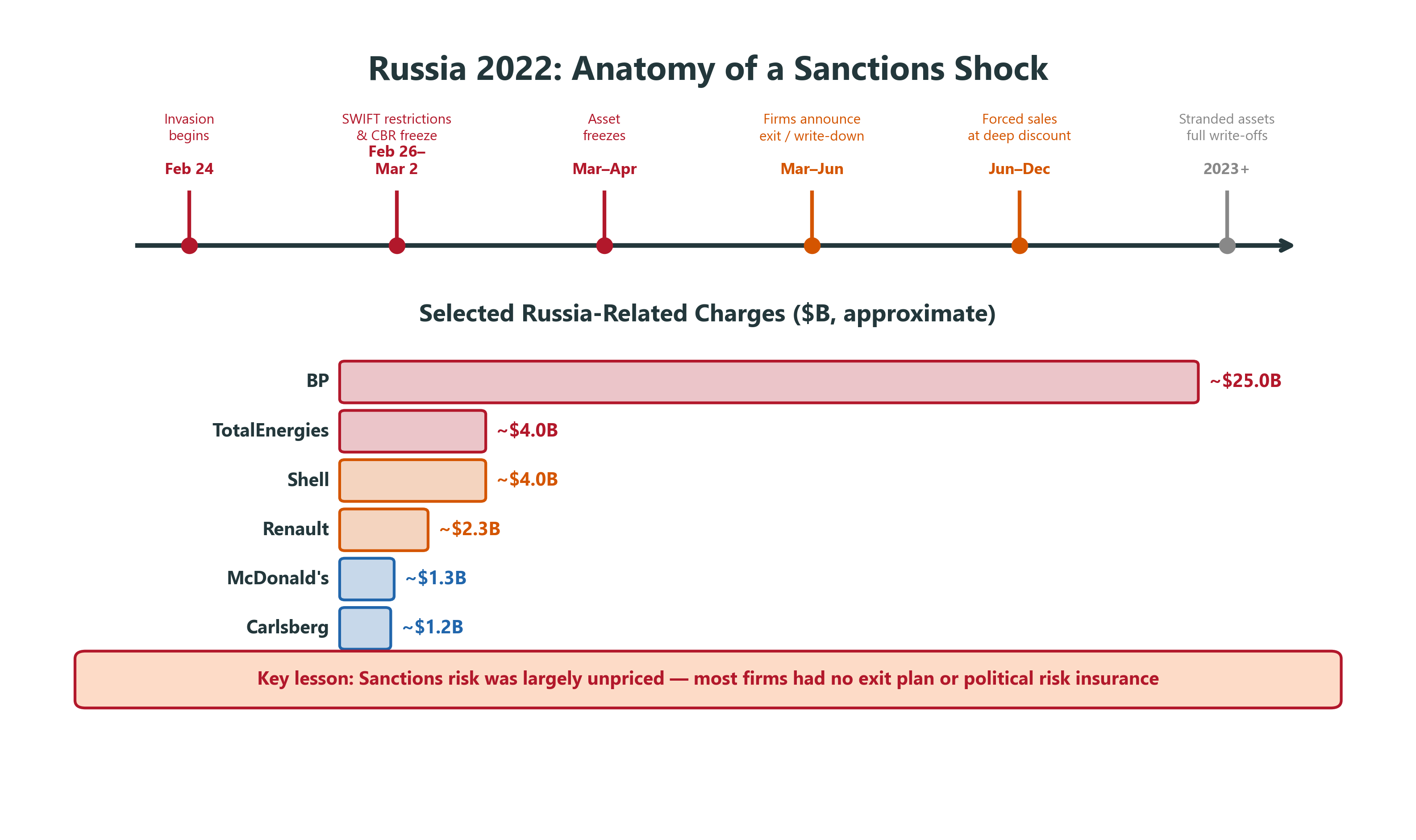
Sanctions as Country Risk: Russia 2022
Lessons from Russia 2022: What Went Wrong
Political risk and sanctions risk were correlated — they hit together, not in isolation
Exposures were treated as ordinary operating assets, not contingent claims
Exit options vanished once sanctions and capital controls arrived
Local partnerships did not eliminate geopolitical exposure
Country-risk scenarios were often too narrow (no sanctions tail)
BP’s Rosneft stake was material to reported reserves, production, and earnings; after the 2022 exit decision, those exposures could no longer be treated as ordinary operating cash flows
Lessons from Russia 2022: Valuation Implications
Include sanctions, asset freezes, and forced-exit scenarios in scenario analysis
Model timing: losses can occur suddenly, not gradually
Preserve abandonment and exit options where possible
Diversify across geopolitical blocs, not only across projects or countries
Monitor sanctions, export controls, payment systems, and ownership rules
Scenario probabilities should reflect deal-specific protections (insurance, exit triggers, structuring) — not just country-level averages.
ESG and Climate as Country Risk
Stranded asset risk:
Fossil fuel investments in carbon-dependent countries (Saudi Arabia, Nigeria, Indonesia)
If global transition accelerates, these assets lose value regardless of country stability
Physical climate risk:
Infrastructure in flood/drought-prone areas (Bangladesh, Vietnam)
These risks compound over the project’s life
Transition risk: carbon border adjustments (EU CBAM) penalize countries without carbon pricing
Climate Risk in the CF Framework
Use scenario analysis (Method 2) with climate-specific scenarios:
Scenario
Prob.
Impact on CF
Orderly transition (Paris targets)
30%
Gradual decline after year 5
Delayed transition (sudden policy)
40%
Sharp decline in year 8-10
No transition (business as usual)
20%
CFs stable, physical risks rise
Accelerated transition
10%
Rapid decline from year 3
TCFD/ISSB provide disclosure frameworks for climate scenario analysis; firms often use external scenario sets such as NGFS or IEA
Climate-transition and physical risks belong in scenario cash flows — carbon prices, CBAM, stranded assets, capex needs, and disclosure costs should be modelled explicitly
Climate risk is back-loaded (10+ years) — DR adjustment even less appropriate
Discount rate doesn’t change — these are CF adjustments
BEPS Pillar Two: Mechanics
OECD/G20 global minimum tax framework
Applies to MNE groups above the €750M consolidated revenue threshold (smaller firms out of scope)
Targets a 15% effective minimum tax rate per jurisdiction
Operates via IIR (income inclusion), UTPR (undertaxed profits) and QDMTT (qualified domestic minimum top-up tax)
If a subsidiary’s effective rate < 15%, a top-up is collected — often domestically via a QDMTT, otherwise via the parent
Implementation began from 2024 onward, but timing and mechanics vary by jurisdiction
Implementation is evolving and jurisdiction-specific; update examples before teaching.
BEPS Pillar Two: Valuation Implications
Reduces value of tax holidays and low-tax structures for in-scope MNEs
Raises effective tax rates in some jurisdictions; tax incentives become less durable
Increases compliance and reporting costs; requires scenario analysis for jurisdiction-specific timing
Tax shields from low-tax subsidiaries may shrink for in-scope groups (affects APV Step 2)
Country attractiveness shifts toward real factors: infrastructure, talent, supply chains
Pillar Two affects expected cash flows and APV side effects, not the country-risk spread.
Part 6: Putting It All Together
Worked Example: Vietnam Manufacturing Plant
A US firm is evaluating a $50M manufacturing plant in Vietnam
For simplicity we ignore taxes on insurance premiums in this example, and we discount the premium stream at the project discount rate. In a full APV, the premium stream could be discounted at a rate reflecting the risk and contractual nature of the obligation.
Comparing All Three Methods
Method
NPV
Comment
DR adjustment (wrong)
$13.8M
Conceptually flawed, inflexible
CF adjustment (bond-implied)
$12.6M
Consistent estimate, but binary
APV with insurance (preferred)
$17.1M
Market-priced, deal-specific
Difference: $3.3M between DR and APV approach (19% gap)
DR and CF methods give similar results when derived from the same spread
The APV method is substantially higher because the insurance premium reflects deal-specific risk, not the full sovereign spread
In practice, supplement Method 3 with scenario analysis for uninsurable risks (sanctions, climate, regulatory changes)
The Complete Cross-Border Valuation Toolkit
Step
Component
Lecture
1
Base-case NPV (all-equity, no country risk)
L10 (APV)
\(\hookrightarrow\) Discount rate
L11 (ICAPM)
\(\hookrightarrow\) Cash flows in domestic currency
L11 (returns)
2
+ Tax shields
L10 (APV Step 2)
3
+ Financing side effects (subsidies, guarantees)
L10 (APV Step 3)
4
– Country risk adjustment
L12 (this lecture)
\(\hookrightarrow\) CF adjustment or APV with insurance
Course Connections
L3 (PPP) \(\rightarrow\) determines if FX risk is real
L5 (UIP / carry) \(\rightarrow\) is there an FX risk premium?
L6–8 (hedging) \(\rightarrow\) can you hedge FX risk? At what cost?